
Legal Disclaimer: This content is published for informational and educational purposes only and does not constitute tax, legal, financial, or immigration advice. I am not a certified professional in these fields. Any actions you take based on this article are strictly at your own responsibility. Always consult licensed professionals regarding your specific situation and current Paraguayan regulations.
This post is only for those who already have Paraguayan residency or are planning to obtain one. I trust you do not need previous accounting experience for the checks I am sharing below, and you do not need to speak Spanish either.
When I obtained my residency in Paraguay in 2020, my international tax advisor recommended the country because it was not widely known as a tax haven destination like the Cayman Islands, the Bahamas, Dubai, or even Panama.
As annually between 25,000–40,000 people obtain residency status in Paraguay, I estimate that around 150,000 people may have obtained residency since I did. Therefore, this “low visibility” advantage is probably no longer fully true. However, Paraguay is still excellent for entrepreneurs, 100% remote workers, investors, or those who simply want to live a quiet life from savings or pension — far from the craziness of the rest of the world.
Note: You should not maintain this residency if you already have tax residency elsewhere. Paraguay participates in international transparency frameworks and is becoming increasingly integrated into international banking systems for better visibility. Most countries are serious about determining where the centre of your life is located (especially in the EU and in the US).
Paraguay can be a good solution if you are a frequent traveler and not holding any tight relationship of any single countries (not having a residency anywhere). As a general rule, you must have a country what you call your “home country” and where you pay your taxes. Then Paraguay may offer a solid combination of immigration residency and tax residency. With your Paraguayan ID card, you have the legal right to live in the country, and you can also obtain a tax certificate proving economic ties.
About establishing Permanent Residency in Paraguay, you can read in this post and this one.
In this post, I write about Paraguayan tax residency and some high-level details you should know about.
What Is a “RUC” in Paraguay?
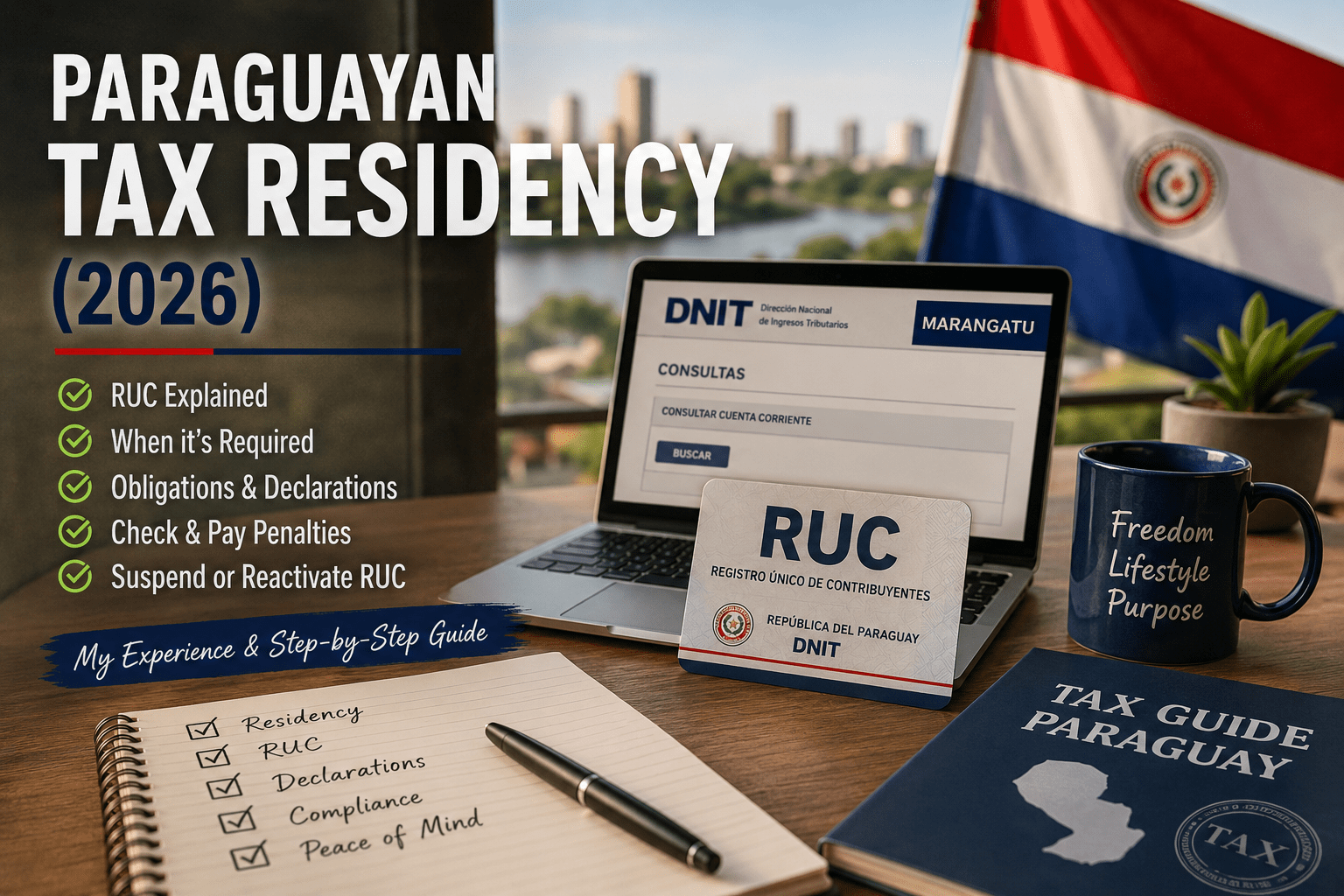
If you get residency, one of the most important concepts you must understand is the RUC, which stands for “Registro Único de Contribuyentes”. This is the Taxpayer Identification Number, similar to the German “Steuer-ID” or the Hungarian “adószám”.
Paraguay’s tax authority used to be called SET and is now called DNIT.
When RUC Is Required or Good to Have
When we received our residency permits, we first got our Paraguayan ID cards. Then we needed to apply for the RUC code, which itself took another 2–3 months. For the RUC process, we did not need to remain in the country permanently; we only had to wait for it to be issued.
Our agent, who helped us obtain both residency and the RUC, also mentioned that many nomads arriving for residency are not aware that the RUC can be just as important as the ID card itself.
RUC is mainly used for reporting economic activity. As you may know, Paraguay generally taxes only Paraguayan-source income and is not focused on worldwide income.
You usually need a RUC if you:
- have freelance activity
- invoice clients using your Paraguayan address or business (“facturas”)
- run a company in Paraguay
- show any economic activity in Paraguay
- are an investor in the country, for example renting out properties
My own example was that me and partner were frequent travellers (not stayed in any country longer than 183 days due to my job). I worked as a freelancer internationally and had no business activity in Paraguay. Yet, a monthly “zero activity” declarations using my RUC number were required.
When RUC Is Not Required Immediately — or At All
There are scenarios where a RUC is not necessarily required. Some agents helping you obtain residency may recommend getting it anyway, even if you do not need it. However, why spend hundreds or even thousands of dollars on something unnecessary?
Some examples where a RUC may not be needed:
- you are retired
- you are fully employed abroad and have no business activity in Paraguay
- you live from savings or pension and simply enjoy life
If your circumstances are not listed here, I strongly recommend contacting a trustworthy local tax advisor or accountant before deciding whether you need a RUC.
What Are Your Obligations With a RUC?
Most people hire an accountant to handle the paperwork and monthly submissions. Not because the system is extremely complicated, but because it is easy to make mistakes in the online platform.
You or your accountant may need to complete:
- monthly declarations
- VAT filings if applicable
- bookkeeping if you have expenses or invoices
- keeping records and paying fees or fines
- zero-activity declarations, even without economic activity
- maintaining active or frozen status
My experience is that late declarations can easily generate penalties. Some accountants take advantage of the fact that clients rely on them 100%, and they may miss penalties in the system. I discovered my own penalties years later when I decided to take over the monthly declarations myself.
Next, I will share how you can check penalties and pay fines yourself.
How to Check if You Owe Money to the Paraguayan Tax Authority
You may either manage your taxes yourself using the Marangatu system or hire an accountant to handle your submissions. I paid an accountant for four years to submit our monthly declarations. At the beginning of last year, however, I decided I wanted more control and asked a friend to show me how to submit the declarations myself.
Only accidentally did I discover that both my wife and I had outstanding fines for years — apparently ignored or missed by the accountant. I always had trust issues regarding Paraguayan accountants because I never saw any proof of what was being submitted. I simply paid annually.
Now it seems he submitted only the basic returns, except for two months that were apparently forgotten, resulting in fines.
CONSULTAS / CONSULTAR CUENTA CORRIENTE – BUSCAR
- Login to the Marangatu system
https://marangatu.set.gov.py/eset
2. Navigate to CONSULTAS / CONSULTAR CUENTA CORRIENTE and click on “Búsqueda”.
3. On the next page, you can see whether you have outstanding reports to submit or any fines.
4. The “Periódico” column shows which month has the missing declaration. “Total Deuda” shows the amount of the penalty in Guaraní.
Note: You may still need to file the missing declaration for that month before paying the fine.

Generating a Payment Ticket for the Fine
First, you must generate a payment “ticket” with a barcode that can later be used to pay the fine.
The easiest method is to search for “Bol” in the search bar and select “Generar Boleta Pago”. You should then see the fines listed like this:

Next, enable the toggle switch.

Check the total amount. Bottom-right should change to “Total del Pago = XXX.XXX”.
This confirms the payment slip is ready.
Now click on Generar Boleta.
You can either save the generated document as a PDF or simply take a screenshot of it.
Note: The generated boleto is valid only for a short period, usually 1–3 days. Therefore, generate it only shortly before paying.
Paying the Penalty
You need a Paraguayan local bank account to pay the fine yourself. International banks usually cannot pay directly into the local system.
Therefore, you generally have two options:
- Ask a friend or accountant to pay the fine for you. (My first penalty was paid by my ex-accountant as compensation.)
- Leave the fine temporarily until you are physically back in Paraguay and can open a local digital bank account, such as Ueno, using your Paraguayan address and local SIM card.
Is leaving the fine unpaid for months a good idea? Certainly not. However, my own fines were already five years old before I discovered them, so hopefully a few additional months should not create major complications.
Note: If you pay through the Ueno app, our experience was that you must choose “DNIT – SET – Pago Tributos”, enter your birth date in dd/mm/yyyy format, and use only the first seven digits of the RUC code in the “RUC sin dígito verificador” field.
What Happens if Your Residency Status Changes?
Life brings different opportunities, and you may later decide to settle in another country for some time. This happened to me as well.
Only much later did I accidentally learn that once I established tax residency elsewhere, it became unnecessary to continue maintaining my Paraguayan RUC actively. Unfortunately, my accountant never informed me about this, even though he knew my circumstances.
So I am telling you now: if you establish a new tax residency after obtaining Paraguayan residency, you should act and place the RUC into inactive status.
You could permanently close the RUC, but that is generally recommended only if you are 100% sure you will never need it again. Reopening it later can be bureaucratic and expensive.
If you are like me and only temporarily settle elsewhere, then changing the RUC status to suspended is usually the better solution. During that inactive period, monthly declarations should no longer be required. Reactivation is supposed to be relatively simple whenever you need the RUC again for investments, rental income, or issuing facturas.
How to Temporarily Suspend the RUC and Monthly Declarations
Next, I will guide you through how to temporarily suspend your tax activity. I also recommend checking the official DNIT guidance with screenshots.
Maximum duration: The suspension period cannot exceed 60 months (5 years).
Key steps in the Marangatu system:
- Navigate to Solicitudes > Solicitud Actualización > Suspensión Temporal del Registro.
- Enter the “Fecha Desde” (start date). You cannot select a future date. Ideally, the suspension should be filed within 30 business days after stopping activity.
Because you are relocating abroad and changing your tax residency, you may use a description such as:
“Cese temporal de actividades por traslado al exterior”
(Temporary cessation of activities due to relocation abroad)
- According to General Resolution No. 79/21, attaching supporting documentation is generally not mandatory for temporary suspension requests.
- Ensure the “Fecha Hasta” does not exceed the 60-month limit defined by the DNIT.
Final confirmation
Once you click “Enviar Solicitud”, the system usually processes the change immediately. Always check your Buzón Marandu (internal mailbox) and ensure the request status becomes Aprobada (Approved).
If it remains pending, DNIT may request clarification regarding your last invoices.
To verify the suspension:
Navigate to:
CONSULTAS / CONSULTAR REGISTRO UNICO
You should now see:
Estado: SUSPENSION TEMPORAL
Motivo: CESE TEMPORAL DE ACTIVIDAD ECONÓMICA
In simple terms:
- your economic activity is officially stopped
- you are no longer considered an active taxpayer
- new tax obligations should no longer be generated

Post-Suspension Activities
Even if the status shows SUSPENDIDO, you may still have:
- old fines
- old IVA obligations
- missing zero declarations from previous periods
These obligations come from the past and do not necessarily mean the suspension failed.
I still recommend checking and paying any outstanding fines mentioned above.
My experience: After switching to inactive status, the system requested one final declaration for the same month when I submitted the suspension. Then, for some reason, it requested another declaration the following month. I completed it again. Unfortunately, I was not careful enough and only months later noticed another late submission request for the same period. The deadline had already passed, so I submitted again. The missing declarations were automatically converted into a fine of 150,000 Guaraníes.
Obviously this appears to be a system issue, but honestly, I do not want to argue with the Paraguayan tax authorities. I will simply pay it next time I am in Paraguay.
My recommendation is to check Consultas > Consultar Cuenta Corriente every couple of weeks to ensure no unexpected declaration requests appear in the system.
Final Thoughts
I know this post may feel a bit heavy on the first read, but I trust it will help those who prefer to keep more control over their finances and tax matters.
Open Marangatu, navigate through the menus I mentioned, and gain some hands-on experience with the system. Please comment if you found this post helpful and share it on social media too. Also let me know if you notice any incorrect information or think I should add anything else.
Thank you.


